


One Decision, Different Market Reactions


Last week, attention in the global currency market centered on the US Federal Reserve's interest-rate decision and movements in Treasury yields. But while investors tried to read the dollar's next move, Nigeria's foreign exchange market had a different story to tell.
Here's what happened and what it could mean for businesses and individuals dealing with foreign currencies.
THE DOLLAR'S NEXT MOVE WAS STILL UP FOR DEBATE
On October 28, the US Federal Reserve kept its benchmark interest rate unchanged at 3.75%–4.00%.
On the surface, it was a decision to hold steady. But there was more to it.
Two policymakers voted for a 0.25 percentage-point increase, showing that there wasn't a complete agreement on where interest rates should go next.
For investors, this means the direction of the dollar remains closely tied to incoming inflation and employment data.
The US Fed's next move remains uncertain, and movements in Treasury yields added another layer to the story. The 10-year US Treasury yield climbed to 5.05% on October 28 before easing to 4.98% the following day.
These movements reflect how investors continue to reassess interest-rate expectations and the broader economic outlook.
The Naira Gained Ground
Things looked a little different in Nigeria.
While global investors watched the US Fed, the naira recorded a stronger performance in the official foreign exchange market.
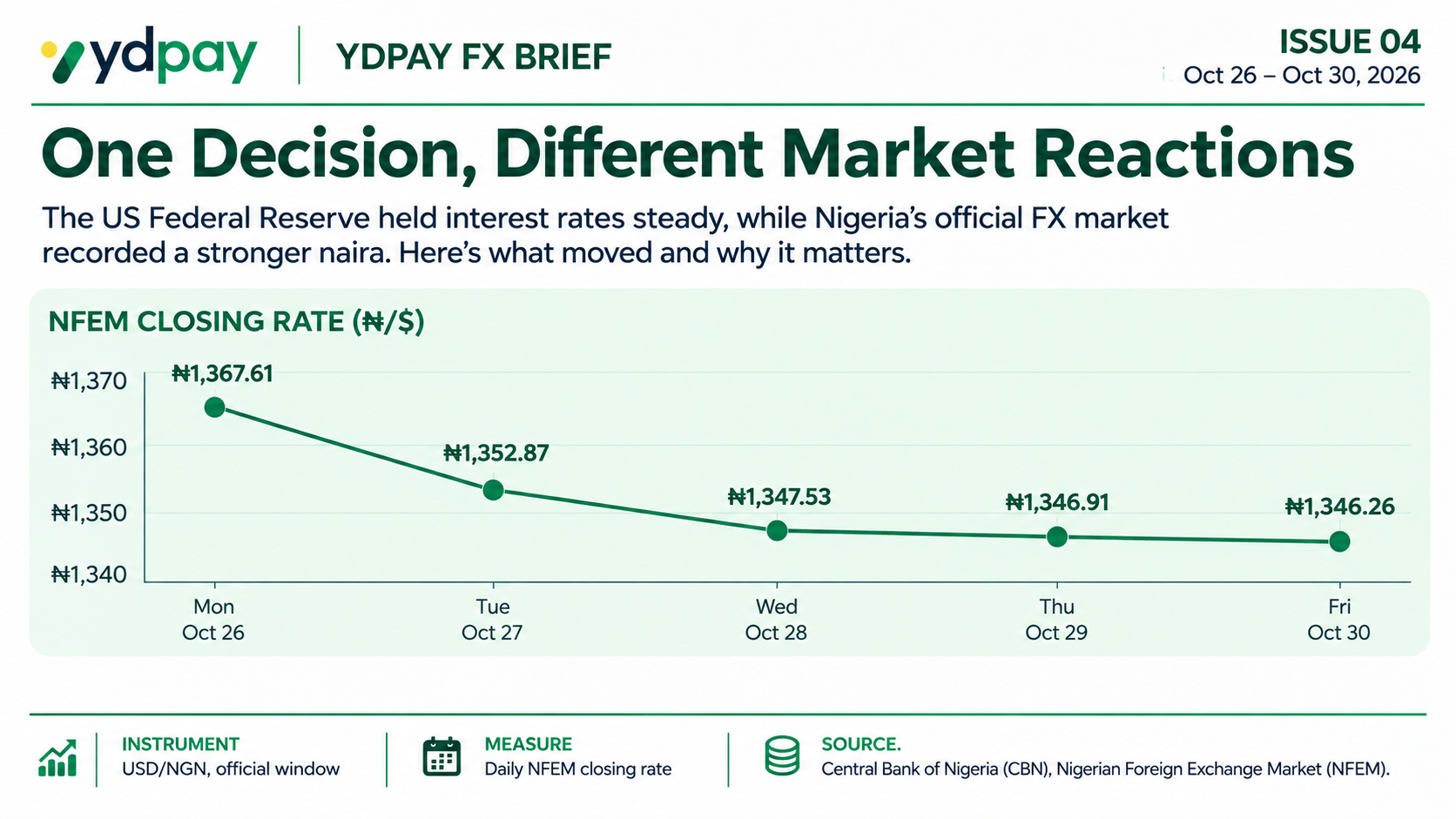
Here's a look at how the NFEM closing rates moved throughout the week:
Date
NFEM Closing Rate (₦/$)
Monday, October 26
1,367.61
Tuesday, October 27
1,352.87
Wednesday, October 28
1,347.53
Thursday, October 29
1,346.91
Friday, October 30
1,346.26
The dollar closed at ₦1,367.61 on Monday and ₦1,346.26 on Friday.
That's a difference of ₦21.35 in the cost of one dollar, representing approximately 1.56% appreciation in the naira over the week.
In practical terms, it meant that fewer naira were needed to purchase a dollar by the end of the week compared to Monday.
It's a welcome movement, particularly for businesses that rely on foreign currencies to pay international suppliers, settle invoices, and manage cross-border transactions.
Why These Movements Matter to Nigeria
US interest rates may seem far removed from the everyday realities of Nigerian businesses, but the connection is closer than it appears.
When US interest rates remain relatively high, dollar-denominated investments can become more attractive to international investors. This can influence capital flows and demand for the dollar across emerging markets.
Treasury yields also matter because they help shape investor expectations about the dollar and other financial assets.
However, there's an important distinction to make: the naira's performance isn't controlled by the US Federal Reserve.
Domestic dollar supply, foreign reserves, export earnings, investor confidence and liquidity in Nigeria's FX market all influence how the naira performs.
In fact, the naira had already begun appreciating before the US Fed's October 28 announcement. This suggests that domestic market conditions and other external factors were also contributing to its movement.
For businesses, the takeaway is simple: global developments matter, but understanding local FX conditions is just as important.
WHAT SHOULD WE KEEP AN EYE ON?
The coming days will offer more clues about where the dollar and other currencies could be heading.
Here are a few things worth watching:
US inflation data: Will inflation give the Fed room to reconsider its interest-rate position?
Treasury yields: Will yields continue to fluctuate or settle?
Dollar performance: How will investors respond to changing expectations around US monetary policy?
Nigeria's FX market: Can the naira maintain its recent gains, and how will dollar supply and market liquidity influence its direction?
For Nigerian businesses with international payment obligations, these movements are worth monitoring. Even small changes in exchange rates can affect how much it costs to pay suppliers, settle invoices and manage foreign currency expenses.
THE BOTTOM LINE
The dollar spent the week keeping investors guessing, while the naira managed to gain some ground at home.
But one week's appreciation doesn't necessarily signal a lasting trend. Both global monetary policy and domestic market conditions will continue to shape what happens next.
For anyone managing international payments, staying informed about both markets can make a difference when planning currency transactions.
That's it for this week's Market Pulse. See you next week!
Disclaimer: This content is for informational and educational purposes only and should not be considered financial advice.


Related Articles




Stay in the loop with market trends.


