


Things Took a Turn in the Market


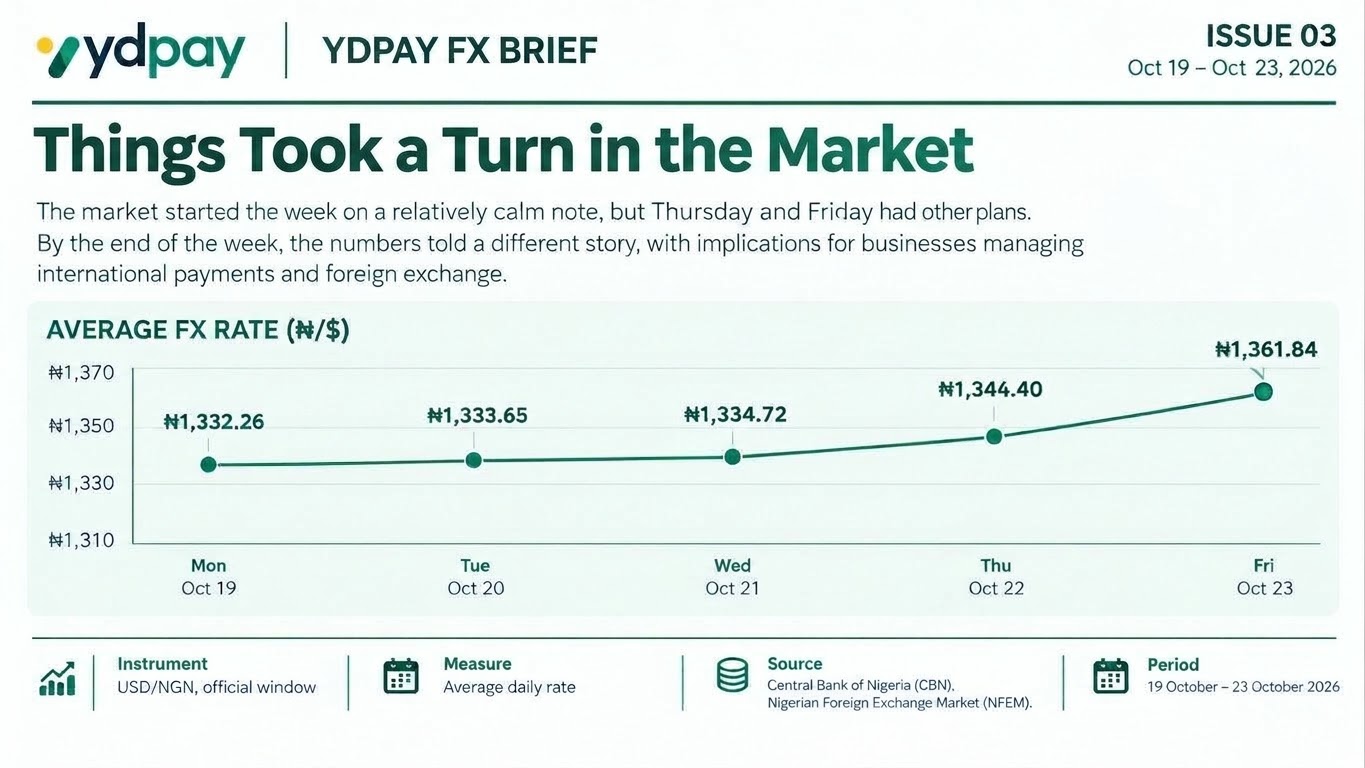
The market started the week on a relatively calm note, but Thursday and Friday had other plans. By the end of the week, the numbers told a different story, with implications for businesses managing international payments and foreign exchange.
Here's how the week unfolded.
Five Days, Two Very Different Market Moods
Here is how the exchange rate moved during the week.
Date
NFEM Rate (₦/$)
Observation
Monday, October 19
₦1,332.26
Relatively stable.
Tuesday, October 20
₦1,333.65
Marginal weakening.
Wednesday, October 21
₦1,334.72
Continued gradual depreciation.
Thursday, October 22
₦1,344.40
Increased downward pressure.
Friday, October 23
₦1,361.84
Sharp depreciation.
The rate moved from ₦1,332.26 to ₦1,361.84 per dollar, representing a depreciation of approximately 2.22% over the week.
That might look like a small percentage on paper, but when you're paying international suppliers in dollars, even a few naira can make a noticeable difference.
And that brings us to the big question: What was pushing the dollar higher?
Four Things That Put Pressure on the Naira
A. Importers Needed Dollars. The Calendar Didn't Help.
As businesses prepare for the holiday season, some begin stocking up on goods, raw materials and inventory. For importers, that often means one thing: more dollars needed for payments.
When more businesses compete for available dollars, buyers may have to pay more to secure them.
Think of it like trying to buy a popular item during a festive-season rush. The more people looking for it, the more competitive the buying process can become.
The difference? With foreign exchange, the price change can affect entire business budgets.
Reuters reported on October 22 that seasonal import demand was contributing to pressure on the naira.
B. FX Trading Activity Went Into Overdrive
Friday wasn't just about a weaker naira. It was also a busy day in the foreign exchange market.
According to Business Day, interbank FX turnover rose to approximately $1.01 billion on Friday, compared with $316.55 million on Thursday.
That's a substantial jump in trading activity.
Higher turnover can reflect increased demand, increased supply, larger transactions, or a combination of factors. It tells us that more money changed hands, but not necessarily why every transaction took place.
What stands out is that trading activity increased significantly while the naira continued to weaken.
In short, the market was busy, but that activity didn't stop the dollar from gaining ground.
C. The CBN Intervention
When demand for dollars rises, the Central Bank of Nigeria can intervene by supplying foreign currency to the market.
Reports from the period indicated that the CBN sold dollars during the week to help meet demand.
Yet the naira continued to weaken.
This doesn't necessarily mean intervention had no effect. Without it, the exchange rate might have moved differently. What it shows is that supplying dollars doesn't automatically guarantee a stable exchange rate.
The outcome depends on how much currency is available, how much buyers need and when those needs arise.
D. Investors Were Also Making Moves
Reuters also reported that investor profit taking on Nigerian securities was contributing to pressure on the naira.
Here's how that can work: an investor sells a naira-denominated asset and decides to convert the proceeds into dollars. That conversion creates additional demand for foreign currency.
Your Dollar Budget Just Got More Expensive
Let's bring the numbers closer to home.
Imagine your business needs to pay a supplier $10,000.
At the Monday rate of ₦1,332.26 per dollar, that payment would cost approximately ₦13.32 million.
At Friday's rate of ₦1,361.84, the same payment would cost approximately ₦13.62 million.
That's an additional ₦295,800 for the exact same $10,000.
Same supplier. Same invoice. Same $10,000.
Different naira bill.
And that calculation doesn't include bank charges or other transaction costs.
For businesses working with tight margins, this difference can affect profitability, especially when the cost cannot easily be passed on to customers.
So, What Should Businesses Do?
Watch your rates: A quotation made today may not reflect the exchange rate available when payment is eventually processed.
Pay attention to timing: Delays between agreeing on a price and settling an invoice can introduce additional currency risk.
Build realistic FX costs into your pricing: Where appropriate, quotation-validity periods and pricing buffers can help businesses manage unexpected movements.
Look beyond the headline rate: Transaction fees, execution rates and settlement delays can all affect the final amount paid.
And one more thing: a weaker naira doesn't automatically mean higher profits for businesses handling foreign exchange. The outcome depends on transaction volumes, pricing spreads, acquisition costs, and settlement expenses.
What Should We Watch This Week?
Rather than rushing to predict the next move, here are five things worth watching:
- Dollar demand: Will importers continue seeking more foreign currency as the festive season approaches?
- FX turnover: Will trading activity remain elevated, and how will the exchange rate respond?
- CBN intervention: Will further dollar sales help moderate pressure in the official market?
- Investor activity: Will portfolio adjustments continue to influence demand for dollars?
- The gap between official and parallel market rates: Will the difference widen or narrow?
None of these indicators can tell us exactly where the naira is headed. Together, however, they can provide a clearer picture of what's happening in the market.
The Bottom Line: The Dollar Made Its Move. Businesses Need to Be Ready.
The naira began the week relatively stable but ended it under renewed pressure, with the reported NFEM rate reaching ₦1,361.84 per dollar on Friday.
For businesses with international suppliers, the takeaway is straightforward: don't let a currency movement turn a well-planned transaction into an unexpected expense.
Monitor the market, understand your settlement costs, and plan your foreign exchange needs carefully.
Because when your supplier wants dollars, your customers want stable prices and your budget wants to balance, every naira counts.
We'll keep you updated. Until then, keep an eye on the market, and see you next time!
Disclaimer: This content is for informational and educational purposes only and should not be considered financial advice.


Related Articles




Stay in the loop with market trends.


