


Why Did the Dollar Move Last Week? The Story Behind ₦1,326


Why Did the Dollar Move Last Week? The Story Behind ₦1,326
If you checked the dollar rate on Monday and checked it again on Friday, you probably noticed something interesting.
The number had moved.
Not dramatically. Not enough to cause panic. But enough to make you ask:
“What actually happened?”
That is the part of the exchange rate story we don't always talk about.
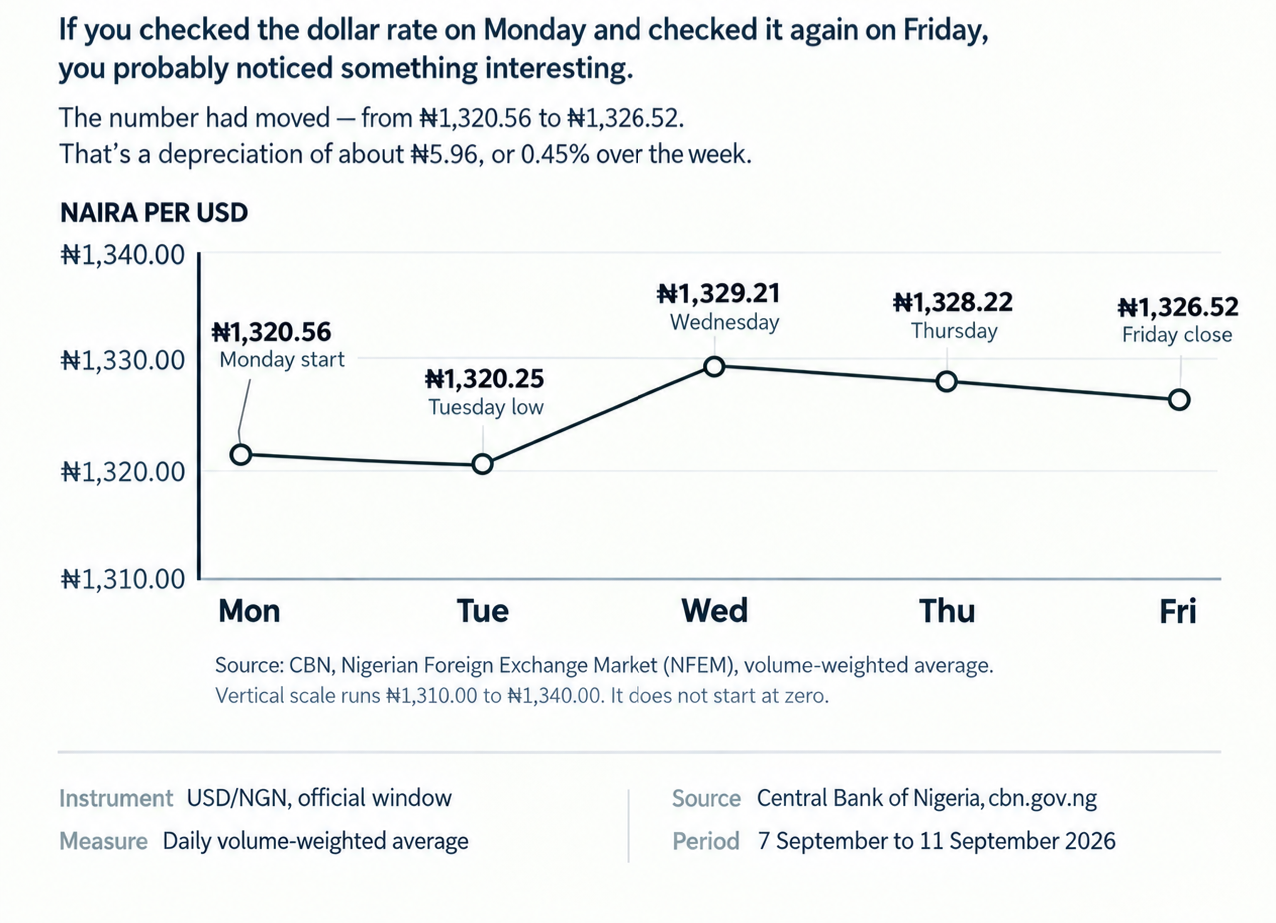
Last week, the naira started around ₦1,320.56/$ on Monday and ended around ₦1,326.52/$ on Friday. That is a depreciation of about ₦5.96, or 0.45% over the week.
On the surface, it looks like a small movement.
But exchange rates are rarely just about the number you see.
The week started quietly
Monday was relatively calm.
The naira traded around ₦1,320/$, with the volume-weighted average coming in at ₦1,320.56. NFEM turnover was also relatively low at about $107 million, showing that trading activity was quite subdued at the start of the week.
Then Tuesday came, and the rate barely moved.
The naira actually recorded the week's lowest level at about ₦1,320.25/$.
At this point, if you were only looking at the exchange rate, there wasn't much of a story.
But the market was about to get busier.
Then Wednesday changed the mood
By Wednesday, the naira moved to about ₦1,329.21/$.
This was the biggest jump in the week.
One reason to pay attention here is market activity.
FX markets work on buyers and sellers. When more participants enter the market and demand for dollars changes, the price adjusts.
And that is exactly what we saw as trading activity picked up.
NFEM turnover increased to about $544 million on September 9, before rising sharply to $1.45 billion on September 10. That Thursday figure was more than double Wednesday's turnover and represented the highest daily level since July.
So, the movement wasn't happening in an empty market.
There was money moving.
There were more transactions.
There were more people actively buying and selling dollars.
And naturally, the price had to respond.
Here is the interesting part
The naira didn't continue falling.
On Thursday, after reaching around ₦1,329.21/$ on Wednesday, it strengthened slightly to about ₦1,328.22/$.
By Friday, it closed the week around ₦1,326.52/$ based on the NFEM data.
That tells us something important:
The market was adjusting, not collapsing.
There was pressure on the naira during the week, but there was also enough dollar liquidity and market participation to prevent the move from becoming much larger.
Nigeria's external reserves had also crossed the $54 billion mark around the beginning of the month. Stronger reserves give the CBN more room to manage foreign-exchange liquidity and can improve confidence in the country's ability to meet dollar obligations.
So, did the dollar really “rise”?
Technically, yes.
But this is where looking at the headline alone can be misleading.
The dollar went from roughly ₦1,320.56 to ₦1,326.52 during the week.
That is only a 0.45% increase.
And when you look at the five trading days, the story becomes clearer:
₦1,320.56 → ₦1,320.25 → ₦1,329.21 → ₦1,328.22 → ₦1,326.52
It moved up.
Then down slightly.
Then up.
Then back down.
That is what an active market looks like.
What should we be watching now?
The interesting question isn't simply:
“Will the dollar go up or down next week?”
It is:
“What is happening underneath the rate?”
Watch three things.
First, FX liquidity.
If there are enough dollars available in the market, sudden increases in demand may have a smaller impact on the naira.
Second, trading activity.
A move accompanied by very high transaction volumes tells a different story from a move happening in a quiet market.
Third, dollar demand.
Importers, businesses, investors and other market participants all need dollars for different reasons. When demand increases faster than available supply, the naira can come under pressure.
And that is why the exchange rate is more than just a number on your phone.
It is a small window into what is happening across the economy.
So next time you check the dollar rate and see that it has moved from ₦1,320 to ₦1,327, don't just ask:
“How much is dollar today?”
Ask:
“What changed in the market?”
That question will tell you much more.
Until next week, keep watching the numbers but don't forget to look at the story behind them.



Related Articles


.jpeg)






Stay in the loop with market trends.


