


The Dollar Tested the Naira. The Market Barely Blinked.


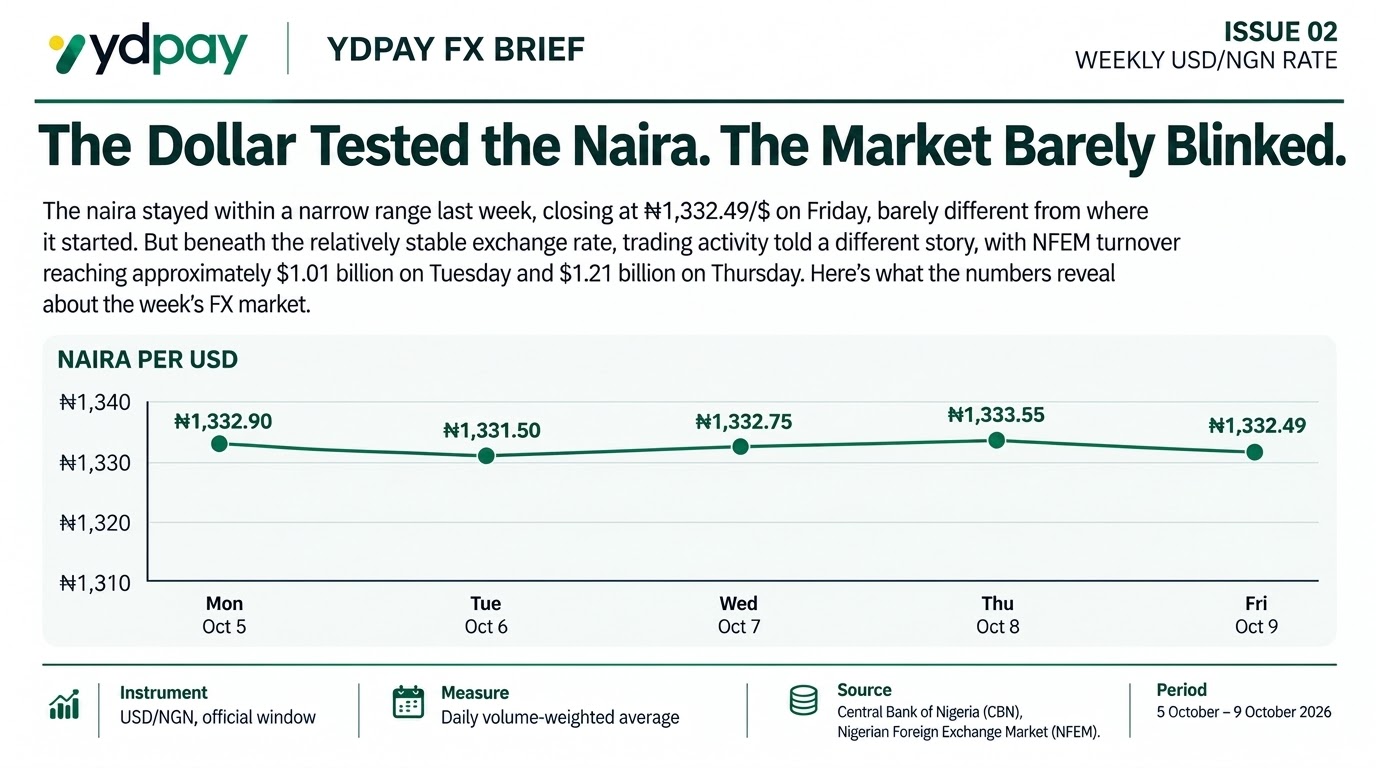
Nigeria’s FX market remained remarkably stable last week, even as global markets grappled with rising oil prices, geopolitical tensions and renewed concerns about inflation. But beneath the calm closing rates, trading activity told a more interesting story.
If you looked only at the dollar-to-naira exchange rate last week, you might have concluded that very little happened. But the numbers behind the rate tell a different story. Let's take a closer look.
A Week of Small Moves and Big Trading Days
The naira began the week at ₦1,332.90/$ before strengthening to ₦1,331.50/$ on Tuesday. It then weakened slightly on Wednesday and Thursday, closing at ₦1,332.75/$ and ₦1,333.55/$, respectively.
By Friday, the currency recovered some ground, ending the week at ₦1,332.49/$.
The week's highest closing rate came on Thursday, while Friday's close brought the market back below Tuesday's level. Here’s how the week unfolded.
Trading Day
Closing Rate
Monday, October 5
₦1,332.90/$
Tuesday, October 6
₦1,331.50/$
Wednesday, October 7
₦1,332.75/$
Thursday, October 8
₦1,333.55/$
Friday, October 9
₦1,332.49/$
The takeaway is simple: the naira experienced modest daily fluctuations but finished the week close to where it started.
However, the week's most interesting development was not the exchange rate itself. It was the amount of money changing hands.
On Tuesday, October 6, reported NFEM total turnover reached approximately $1.01 billion. On Thursday, October 8, it climbed further to about $1.21 billion.
These were significant trading days, even though the exchange rate remained within a relatively narrow range.
This distinction matters. A stable exchange rate does not necessarily mean a quiet market. Substantial trading can take place without producing a dramatic change in the closing price.
Beyond Nigeria: What Was Happening in the Global Market?
The naira's performance cannot be explained by domestic activity alone. Nigeria's FX market operates within a global financial system where oil prices, investor sentiment, interest-rate expectations and geopolitical developments can influence currency demand and the availability of foreign exchange.
Last week, three international developments stood out.
1. Oil prices brought both opportunity and uncertainty.
Oil prices surged on Thursday, October 8, amid escalating Middle East tensions and concerns about possible disruptions to energy supplies. Threats to shipping routes and production concerns in the Gulf of Mexico added to the uncertainty.
By Friday, prices had eased after US President Donald Trump ruled out military strikes against Iran ahead of the November midterm elections. China's resumption of fuel exports also helped ease some supply concerns.
For Nigeria, the implications are two-sided. Higher crude oil prices can support export earnings and foreign exchange inflows, provided production volumes and actual receipts hold up. However, expensive oil also raises fuel and transportation costs, potentially adding to domestic inflation and demand for foreign currency.
The effect on the naira therefore depends on whether stronger export receipts outweigh the pressures created by higher energy costs and other external risks.
2. The US dollar remained supported by global uncertainty.
International currency markets faced pressure from geopolitical tensions, concerns about government debt and uncertainty over the direction of US monetary policy.
Investors continued to assess the outlook for US interest rates and inflation, while fiscal concerns in France weakened the euro and helped support demand for the dollar.
A stronger dollar can make dollar-denominated imports more expensive for countries such as Nigeria. It can also influence global capital flows and the cost of obtaining foreign currency.
However, the dollar's strength against other international currencies does not automatically translate into a weaker naira. Nigeria's exchange rate also depends on local dollar supply, import demand, capital flows and conditions within the domestic FX market.
3. Inflation concerns kept financial markets on edge.
Rising energy costs and elevated government bond yields renewed concerns about how quickly inflation could ease across major economies.
This matters because persistent inflation can influence central banks' interest-rate decisions. Higher interest rates in the United States, for example, can make dollar-denominated assets more attractive to international investors, depending on the wider economic outlook.
For emerging markets, these changes can affect capital flows, borrowing costs and currency stability.
Nigeria is not insulated from these developments. But their impact on the naira depends on how they interact with domestic economic conditions and the supply of foreign exchange.
What Does This Mean for Businesses?
For Nigerian businesses that import goods, pay international suppliers or maintain dollar-denominated obligations, a relatively stable exchange rate offers some breathing room.
It can make short-term budgeting easier and reduce the risk of unexpected currency-related cost increases.
However, last week's figures also demonstrate why businesses should not base their FX decisions on the closing rate alone.
A market can experience substantial trading activity while the exchange rate barely moves. Businesses therefore need to monitor not only the rate but also liquidity conditions, transaction costs and the timing of their foreign-currency obligations.
For exporters and businesses earning in dollars, the same stability may offer greater predictability when converting foreign earnings into naira.
The important question is not simply whether the naira appreciated or depreciated. It is whether businesses can access the foreign currency they need, at a rate and volume that support their operations.
The Bigger Picture
The naira finished last week marginally stronger, but the more useful observation is that it remained within a narrow trading range despite considerable activity in the market and uncertainty abroad.
That is encouraging from a short-term stability perspective, but one week is not enough to establish a lasting trend.
The next thing to watch is whether the naira continues to trade within this range, whether foreign-exchange turnover remains elevated and how developments in the global oil and dollar markets feed into Nigeria's FX supply and demand.
For now, the naira's story is one of relative stability, not a decisive change in direction. And in a market where global events can quickly change the outlook, that distinction matters.
See you next week.
Disclaimer: This content is for informational and educational purposes only and should not be considered financial advice.



Related Articles






Stay in the loop with market trends.


