


The Dollar Had a Rough Week. Why Did the Naira Barely Move?


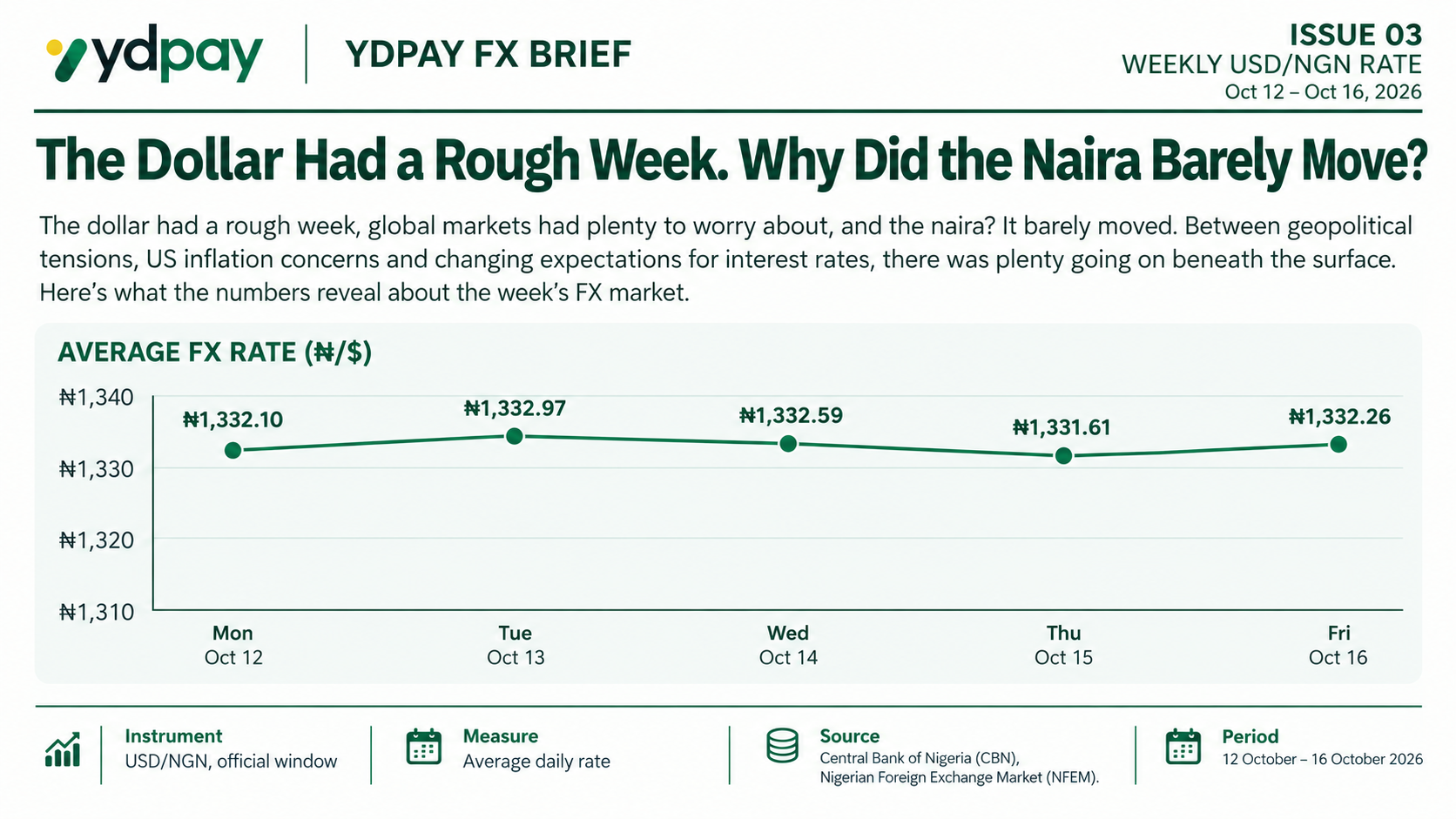
The dollar had a rough week, global markets had plenty to worry about, and the naira? It barely moved.
But a steady exchange rate doesn't mean nothing happened. Between geopolitical tensions, US inflation concerns and changing expectations for interest rates, there was plenty going on beneath the surface.
So, what kept the naira relatively steady while the dollar went through a week of twists and turns?
Let's get into this week's FX Brief. Fresh from the market, just for you.
The Naira's Week in Numbers
Nigeria's official FX market remained relatively stable between October 12 and 16.
Date
Average FX Rate (₦/$)
Monday, October 12
1,332.0960
Tuesday, October 13
1,332.9728
Wednesday, October 14
1,332.5893
Thursday, October 15
1,331.6139
Friday, October 16
1,332.2582
The average exchange rate moved from ₦1,332.10/$ on Monday to ₦1,332.26/$ on Friday, representing a marginal depreciation of approximately 0.01% for the naira over the week.
The rate peaked at ₦1,332.97/$ on Tuesday before easing over the following two sessions and edging up again on Friday.
While the weekly change was negligible, developments in the global economy created a more eventful backdrop.
So, why did the dollar's global movements have so little impact on the naira?
Well, three international developments help explain what happened.
1. Middle East Tensions Pushed Investors Towards the Dollar
The week began with renewed geopolitical concerns.
On October 12, the dollar index climbed to 102.58, its highest level since April 2025, as escalating attacks in the Middle East increased demand for safe-haven assets. Attacks involving tankers and heightened tensions around Saudi Arabia also pushed Brent crude oil higher, with prices rising to approximately $107.17 per barrel.
When geopolitical risks rise, investors often move towards assets they consider safer and more liquid, including the US dollar. This can strengthen the dollar against other currencies, particularly when uncertainty affects global trade and energy supplies.
Higher oil prices also complicate the outlook for inflation and interest rates.
For Nigeria, the relationship is more nuanced. Higher crude prices can potentially improve export earnings and foreign exchange supply, provided Nigeria benefits from increased export receipts. However, the final effect depends on production volumes, domestic fuel costs, external payment obligations, and how much export revenue actually enters the official FX market.
The takeaway: A stronger dollar globally does not automatically mean a weaker naira. Nigeria's oil earnings and domestic FX supply conditions also matter.
2. US Inflation Complicated the Federal Reserve's Next Move
Inflation was another major driver of currency markets.
Hotter-than-expected US consumer and producer price readings initially strengthened expectations that the Federal Reserve might need to maintain tighter monetary policy. Higher interest rates can support the dollar by making dollar-denominated investments more attractive.
However, the market's response changed as the week progressed.
Despite the inflation figures, comments from Federal Reserve officials suggested there was no immediate urgency to raise interest rates further. This helped ease expectations of another near-term rate increase and reduced some of the support the dollar had received.
This distinction is important because the dollar does not respond to inflation alone; it responds to what inflation means for future interest rates.
If inflation remains high and the Fed signals further rate increases, the dollar could strengthen. If policymakers indicate that existing rates are sufficient, the dollar could weaken even when inflation remains above target.
For emerging markets such as Nigeria, changes in US interest-rate expectations matter because they can influence global investment flows, borrowing costs and investor appetite for emerging-market assets.
However, any resulting effect on the naira depends on Nigeria's own economic conditions and the direction of foreign capital flows.
3. The AI Sell-Off Created an Unexpected Twist
One of the more interesting developments last week came from the technology sector.
Concerns about the profitability of AI-related companies and the debt used to finance data-centre expansion contributed to a sell-off in technology stocks. The concerns also spread into parts of the credit market as investors reassessed the risks associated with the AI investment boom.
Ordinarily, a stock-market sell-off can encourage investors to buy the dollar as a safe-haven asset.
But last week, the relationship was less straightforward.
Investors also moved towards government bonds, pushing Treasury yields lower during parts of the week. Lower yields reduced some of the dollar's appeal, particularly as expectations for further Fed rate increases faded.
By Friday, October 16, the dollar index was down approximately 0.35% for the week, at 101.87. This marked a reversal from the strength seen at the beginning of the week.
This is a useful reminder that currencies are influenced by several competing forces. Even when investors are worried about risk, the dollar's direction depends on where money flows and how interest-rate expectations change.
4. Nigeria's FX Market Told a Different Story
Despite these global developments, Nigeria's official FX market recorded little movement over the week.
Wednesday, October 14, was the busiest day in the supplied dataset, recording 387 transactions and 179 buyers. The two reported trading-value figures totaled approximately ₦1.51 billion.
Friday recorded 310 transactions, while the average exchange rate settled at ₦1,332.26/$.
The combination of trading activity and limited exchange-rate movement suggests that prices remained relatively stable throughout the week. However, the figures alone do not establish whether dollar supply matched demand or whether the market experienced underlying pressure.
More importantly, the slight depreciation in the naira's average rate contrasts with the dollar's broader weakening against major international currencies towards the end of the week.
This highlights a key distinction: the naira's performance is not determined by the dollar's global performance alone.
Nigeria's domestic FX supply, importer demand, oil export receipts, foreign investment flows and monetary policies all influence the official exchange rate.
A weaker dollar globally may ease some external pressure, but it does not guarantee the naira appreciation.
What Should Businesses Watch This Week?
For Nigerian businesses that import goods, pay international suppliers or maintain dollar-denominated obligations, the relative stability of the naira offers some breathing room.
However, businesses should look beyond the closing exchange rate when planning their foreign-currency payments.
Three indicators deserve attention:
- Global oil prices: Sustained higher prices could support Nigeria's foreign exchange earnings if oil production and export receipts respond positively.
- US interest-rate expectations: Changes in the Federal Reserve's outlook could influence the dollar, global capital flows and investor's appetite for emerging-market assets.
- Nigeria's domestic FX supply: The availability of dollars within the official market will remain important in determining the naira's direction.
For businesses, the goal isn't simply to predict where the naira is heading. It's to understand when FX is available, what it will cost, and how to plan payments around those realities.
A relatively stable exchange rate can help with budgeting, but businesses should continue monitoring liquidity, transaction costs, and the timing of their foreign-currency obligations.
The Bigger Picture: Stability Is Not the Same as Strength
Last week offered two contrasting currency stories.
Globally, the dollar moved from geopolitical safe-haven strength towards a weekly decline as expectations for further US rate increases weakened.
In Nigeria, the naira remained broadly stable, with its average exchange rate depreciating by approximately 0.01% between Monday and Friday.
The lesson? A weaker dollar abroad does not automatically mean a stronger naira at home. Nigeria's domestic FX supply and demand still matter.
The real question is whether any global relief will translate into better FX supply and sustained stability in Nigeria's official market.
For now, the naira has held its ground. Whether it can build on that stability will depend on what happens next, both in global markets and at home.
Hope you enjoyed this week's serving of FX news without getting burned! 🔥
See you next week
Disclaimer: This content is for informational and educational purposes only and should not be considered financial advice.


Related Articles




Stay in the loop with market trends.


